Monday, April 20, 2015

Science, Technology and Stewardship

When I started teaching Humanities back in 2010, the unit I always looked forward to the most was the one I called "Science and Technocracy".  I loved it because I got to show Atomic Cafe, and had the chance to lead discussions on issues around technology, a topic so relatable and accessible to the students.  The problem was, there was no rhyme or reason to the unit.  It was sort of, "Let's talk about technology because it's fun and interesting to talk about technology!"  When the unit ended, I always felt a bit of a let-down, as though something important had been missing.

Last year, I intentionally brought stewardship into the discussion for the first time, and this year, I made that the central, underlying theme of the unit: no longer would it simply be technology for technology's sake; it would be about technology with an eye toward stewardship.

I retitled the unit "Media & Power in the Modern Age" and set about planning out just how I would organize the unit in a way that would encourage deep thinking about stewardship.  

Here's what I settled on--
I introduced the unit by having the students read a selection of passages from Scripture, and do some basic thinking about the concept of stewardship before launching into the following modules:

I. Module One: Superpowers in a Nuclear Age
This module provides the historical background for all other discussions--we examined World War II with an in-depth look at the use of propaganda on all sides, as well as the decision to drop the atomic bombs, and then examined the Cold War in broad brush-strokes.

II. Module Two: The Creative Potential of Technology
This module examines all of the exciting new developments that are happening in science and technology today.  We examined assistive communication technology for people with ALS, electronic glasses for the legally blind, Maglev train technology, seawater desalinization and much, much more.  I invited the students into this by holding what I called "TecXpo 2015", a showcase of up and coming technologies, briefly researched and then advertised by the students.  Students gave enthusiastic sales pitches for such technologies as tags that can be attached to possessions (clothes, wallets, keys, etc) and tracked down electronically using a smart phone; invisibility cloaking technology; advancements in virtual reality; air-conditioned suits.

It was exciting to look together at how far technology has come over the past century, and to speculate on what might be possible within our lifetimes.

III. Module Three: The Destructive Power of Technology
We started by watching "The Atomic Cafe", which provides a dark satirical look at the misinformation and fear surrounding the development of nuclear weapons in the 1950s.  We returned to our discussion on the power of propaganda, and discussed how the documentary filmmakers exposed the government's manipulation of facts, and how they downplayed the destructive power of nuclear weapons.  We followed this up with a study and discussion of the first two chapters of "Silent Spring" by Rachel Carson, examining once again the disparity between propaganda and reality, and the devastating environmental impact of DDT and other insecticides.  We will also examine issues related to cyber-bullying and technology addiction.

Before reading from Silent Spring, we filled the whiteboard
with background information about who Rachel Carson was.
IV. Module Four: Choosing Stewardship
We will wrap up this unit by returning to the concept of stewardship.  Students will submit visual projects that they have been working on for a while, in which they must make and test a hypothesis about the role of technology either at CAJ or in their family life.  Students will also debate one of several key issues related to science and technology today, including online education, social networking privacy, genetic engineering and sustainability.  We will conclude with an in-class essay that revisits the students' initial thoughts on stewardship, but deepens them based on everything we will have studied since that first reflection at the start of the unit. 

Now, this unit has some real structure and weight to it--that nagging empty feeling I had in previous years is absent this year, replaced by excitement and joy at the discussions that the students are having.  Our look at issues in science and technology is no longer haphazard and random--it is now focused and purposeful.  I'm eager to read the students' reflections when we finish the unit next week!

Thursday, April 9, 2015

The Search for a Workable Late-Work Policy, PART ONE

I'm calling this PART ONE because I know I'll write a PART TWO as the school-year wraps up, to reflect on the high school-wide After School Assistance Program, of which I was a co-founder.  I guess that's the "macro" look at the late-work policy.  Today I'll offer a "micro" look at what I've done in my own classroom:


Until this year, our school policy for late assignments was fairly typical.  At least, it was strikingly similar to what my own school's late policy had been when I was a student, and to the policies in place at the schools where I student taught:
The score on a late assignment would be reduced by 10% for each day late past the due-date.  After five days, the score would stop decreasing, however beyond that point the students would only receive 50% credit if the work they submitted was of 'B' quality or higher.
I didn't think to doubt this policy in my first few years of teaching because it was so familiar.  Like the fish who doesn't know that the water around him is wet, I just assumed this was the way things were, for better or for worse.

It wasn't until my Master's course on assessment last fall that I began to see flaws in the policy.  In that course, one of my main takeaways was that assessments should reflect students' mastery of skills and understandings; that the data should reflect the student's proficiency.  I came to realize that timeliness, while important, was actually a separate skill from, say, writing.  If I took points off of a students' writing score because they had submitted their essay late, the score would fail to accurately reflect the student's true achievement or needs as writers.

Moreover, the policy simply wasn't working: at the end of the semester, it was not unusual to look down the online list of a class' grades and see the telltale red 'missing' notification next to a number of students' names.  Some students were ending the semester deep in a pit of missing or late assignments, barely scraping by or even failing.

As I was having these realizations, our high school division was discussing the role of homework in general.  Eventually, that discussion came around to the late penalty.  It was soon apparent that while there were a variety of opinions on what a better solution would be, everyone was of one mind in recognizing the brokenness of the late penalty as it was.

I won't go into the policy we came up with in this post, suffice it to say that it was a total departure from what we'd done in the past and I had the (sometimes stressful, sometimes frustrating) privilege of implementing (and fine-tuning) that policy with a fellow social studies teacher.

The question remained, however, what my personal policy would be on late work.

So, I decided to create a "timeliness" score in my gradebook.  It's not a big part of the grade--only 5% of the total--but unlike other scores, timeliness starts at an A.  I give the students each 200 points at the start of the semester.  For each late assignment, I subtract 5% from the total and then make a note of the assignment and the date that will be visible to the students and their parents under the timeliness score.
For one school-week after a due-date, the students will only receive a 5% deduction for submitting late work.  I consider this a "grace period"--the late assignment goes into the grade-book notes to make the parents aware, but the penalty is relatively small and not enough to hurt if it only happens a couple times.  However, after one week has passed, each additional day the assignment does not come in costs another 10 points from the timeliness score.  So, if a student turns in an essay a week and a half late, they would lose 35 points from their timeliness score (the initial 5, plus 30% for three days past the one week mark).
At this stage, the lost points start to sting.  I honestly cannot say that this policy has reduced the number of late assignments, but now the final scores are a more accurate reflection of what my student achieved: the fact is, I do have several excellent writers in my class who are habitually late. Under the previous system, the grades would have inaccurately shown that these students were poor writers; the new system shows the situation as it really is.
That's wonderful and I feel good about that.  But something is still missing... after all, if I'm assessing it, I had better be teaching it!  The next step will be to think through and consciously include instruction and practice in developing better time-use habits.  Perhaps I can offer points if students make and submit a work-schedule for themselves... something along those lines might be valuable, anyway, and might even impart a value for timeliness to even the most chronically late of students!

As promised, I'll talk more later about the policy we adopted as a high school division and how that has worked out.

Sunday, April 5, 2015

A Year of Games and Simulations

This has been the year of classroom simulations.  I've used simulations before, but they were either too drawn out, or half-baked.  This year, I put a lot of energy into using simulations to promote student understanding of both context and concepts.  We did four simulations together in Humanities class this year:

October: Constitutional Convention Simulation
January: Compromise of 1850 Simulation
March: Treaty of Versailles Simulation
April: Atomic Bomb Decision Simulation

In three of these cases, the main purpose of the simulation was to prepare students to do a DBQ on the historical event they had simulated.  The class average increased by nearly 10 points between the first DBQ (on the constitutional convention) and the second.  Essentially, the simulations are a study session wherein the kids familiarize themselves with the events and concepts in play by temporarily immersing themselves in the thick of whatever issue and time period happens to be the focus.

Today, we started our final simulation on the decision to drop the atomic bomb. In previous years, I had dedicated more than a week to this simulation, and it had been a multi-stage formal debate.  Last year, I realized that it was too much, for no clear purpose; moreover, the kids who were not on one side of the debate or the other played too passive a role for that stretch of time.  This year, I truncated it to a two-day in-class activity, more in line with previous class simulations.  Rather than debating formally in front of class, the teams of six would have one period to put their arguments together using a selection of primary sources I compiled for them before being set loose to convince their classmates.  The "indeterminates"--the ten students not on a team--were responsible for coming up with a list of pressing questions they needed the teams to answer, as well as any other information they felt they would need to know in order to make an informed decision.  Tomorrow, we will vote using ballots--whichever side gets more votes wins the simulation (including all who voted for the winning side).

To raise the stakes, I informed the class that all who won would receive 5 extra points on their DBQ, and that if I found them using their computers for off-task purposes, they would forfeit their shot at the 5 extra points.

And just like that the students were off to various corners of the school to research, scheme and plot their strategy to convince their undecided classmates.  Meanwhile, I lectured those ten indeterminate students on presentism, challenging them to step out of their personal views on the bomb.  We had a good 15 minute discussion about all of the important aspects of this decision and together generated a list of key questions and considerations on the board.

When the teams returned after roughly one hour of research and planning, they wasted no time in passionately presenting their case in informal conversations with the indeterminates.  I heard students citing Einstein, Szilard, the Geneva Conventions, casualty statistics from the Battle of Okinawa and the Tokyo fire-bombings, and much more as they sought to win over their classmates.  I'd given each team a warning about not bribing, threatening or trading on social dynamics beyond the simulation and they made good.  It was 50 minutes of intense and heated historically-rooted conversations.

The indeterminates all cited coming away from the conversations feeling less sure of their decision, which I told them was the natural effect of abandoning presentism and allowing their assumptions to be challenged.  Tomorrow, they will vote and we will see whether history will repeat itself or whether the indeterminates will chart a different course.

In either case, I am confident that everyone is ready to tackle our Atomic Bomb DBQ and that even without the 5 point prize to the winners, the scores will be even higher than last time.

Bonus: It was fun to hear the students still heatedly discussing this even after class had ended :)


Monday, March 30, 2015

Total Teacher: Reflection

I wrote this reflection for my Master's course.  We are reading a book entitled What's Worth Fighting for in Your School?  Chapter two maintains that a teacher's personality and background, a teacher's working context, and a teacher's purpose all contribute to who they are as a total teacher (and that these aspects have been traditionally overlooked, to the detriment of teaching and change in schools). The prompt called for us to briefly reflect on these areas for ourselves, and how they relate to our role as a teacher-leader in our school.

----------------------------------------

Everybody comes back to Lynden.  This isn’t true, obviously, but it is a perception shaped by a high rate of returnee-ism not uncommon in small towns in America, and perhaps even more common in Dutch-American communities.  I thought for sure I’d be among that number when I finished college.  I enjoyed my years as a student at Lynden Christian and over the course of four and a half years living in landlocked, flat Iowa for college, I came to romanticize my Washington hometown.  After all, I’m a Pacific Northwest farm-boy at heart, in love with the countryside, provided there are mountains and evergreen trees within view, and the ocean within driving distance, of course.  Maybe this is why God saw fit to send me to teach in the middle of the largest city in the world.  
That’s me—the farm-boy in the big city; the home-body who didn’t return to the nest.  Seven years ago, I wouldn’t have chosen this life for myself, couldn’t have even imagined it, but today I wouldn’t trade it for anything.  I am a product of my Lynden upbringing, to be sure.  Even after six years, I still marvel each day at the diversity of my classroom, compared to the sea of Vans and Vanders that I grew up in.  I get particularly excited when I get to introduce a new group of Juniors to the great outdoors on our annual four-day Wilderness Camp.  The students enjoy my stories about farm-life and small-town life because such a lifestyle is as foreign to them as Tokyo would have been to me when I was in high school. 
At the same time, there’s much that is familiar about CAJ.  It’s a small Christian school, with all that this status entails.  While Tokyo and the international school scene were completely new to me when I started working here, I came in well-versed in the ins and outs of life at a Christian school.  Perhaps this point of connection helped me feel comfortable staying.  In any event, the differences have shaped me in profound ways.  I am irreversibly more internationally-minded than I was growing up.  While I’ll never feel that I fully belong in Japan, I also feel as though I no longer fully belong when I’m in America. When the 2011 triple-disaster hit, I found myself sharing a deep feeling of solidarity with Japan and a deeper solidarity with the CAJ community.  No matter what happens, or where I go, Japan and CAJ will always be a part of me.  Certainly, as my wife is Japanese, even if we eventually were to move to America, we would regularly return to visit Japan, and CAJ.  I don’t have plans to return to America, though.  It’s not as though that’s the goal, or the dream.  For now, this is the dream.  This is home.  
I love America, but I have enough objective distance to see clearly her many faults.  I am not Japanese, but I’m tied to Japan through marriage and I belong to an international community.  These factors of background and context have done much to mold my purpose as a teacher.  “Becoming people of justice” is not merely a convenient catchphrase for me—it’s what I genuinely want for my students to aspire to.  They have a privilege that I did not, growing up in a place where diversity is as natural and valued as the sakura blossoms that are right now blooming in our school plaza.  A place where service is part of the culture.  A place where they are being trained to think and function as global citizens.  Yet, the students cannot take CAJ with them when they graduate, and in some senses that makes our wonderful environment a bit like a hothouse.  I share what knowledge and experiences I can (though I’ve spent most of my adult life here at CAJ) and encourage the students to think deeply about their place in the world; how they will use their gifts and their passions to pursue justice in some fashion or another.  
God has used this combination of my own history, my current context and my purpose to build me into the teacher that I am.  The road has not always been smooth, the journey not always easy.  Yet, I now appreciate more fully that I have a part to play on staff at CAJ.  I am the farm-boy in the city; the home-body who found his element by leaving his element; the graduate of a small-town school where “if ya weren’t Dutch, ya weren’t much”.  My experiences, coupled with my deep hunger to learn more about the art of teaching, have equipped me with much to offer as a leader in my community.  I may not be the most organized or detail-oriented teacher on staff (if I had to guess, I'd say 30th percentile), but just how special CAJ is, and how vital our mission, is not something I take for granted.  With these truths close to my heart, I cannot isolate myself; I must engage my colleagues in professional dialogue; I must share what I’ve learned, and seek to learn from them, in turn.  I must do my part to encourage a desire for ongoing growth and learning among my fellow teachers so that we can better prepare our students to pursue justice; to serve.  This is who I am, and who I am becoming.  I’m a world away from Lynden, but exactly where I need to be. 

Friday, March 13, 2015

Passport to the World

In September, my 11th graders finished our first unit of the year on community.  We discussed the factors that break community down and the role that love can play in building community up.  In our final discussion, I encouraged the class to consider what they might be able to do as a community to serve the world.  I offered a few examples of service activities that classes had done in years past, but told them that it was ultimately their own decision.

The StuCo representatives organized a class meeting during lunch on the first of October to gauge interest in doing something as a class.  The turnout was incredible--more than 40 of the 47 members of the class attended the meeting and those who were not there had prior lunch commitments.  I sat in on that meeting as a fly-on-the-wall.

The feeling at that meeting was abundantly clear: everyone was in favor of doing something.  I encouraged them to decide on a charity to support before starting to plan an event.  Several ideas were considered, among them raising awareness and funds for Ebola research.  The Juniors knew that Ebola was an issue that was not only affecting so many people, but also that it was largely misunderstood by the United States media, which was contributing to Stateside panic (such is the advantage of observing U.S. media from overseas!  A little distance helps to see the truth of a situation).  

As luck would have it, the high school principal knew someone working with the SIM Organization, a branch of which is dedicated to fighting Ebola, and connected the students with that contact. 

Later in October, the students decided that they wanted to host an international festival--a practice common in Japanese schools, but which had not been done in recent memory at CAJ.  They brainstormed the types of games, food, activities and performances that could be featured. The class divided into committees and set about planning. 

One of the greatest obstacles they encountered was setting the date.  As the leaders looked through the calendar, it became clear that there were relatively few open Fridays upon which the event could be done and that even the open Fridays came between other major events.  In mid-January, the Juniors settled on March 12, a Thursday, with the festival lasting from 4:00-6:00.

With the date set, the committees doubled down on their efforts and the event began to take shape.  In February, the Junior class had a tremendous opportunity: through their contact at SIM, they were able to connect with Dr. Rick Sacra, a Christian Ebola doctor who had worked at Elwa Hospital in Liberia, had gotten sick with Ebola in the fall and then survived to return to his work.  The class leaders arranged a Skype interview with Dr. Sacra on February 25.  They set up the projector in the classroom and filmed the hour-long interview.  Dr. Sacra was helpful, gentle and very informative and the students came away, in the words of one girl, "star-struck".  

In the weeks leading up to the event, the committees went above and beyond: the arts committee and decorations committee spent hours after school putting together signs and planning how they would transform the cafeteria into an international carnival.  The food committee spent hours in the Home Ec room, preparing food to be baked ahead of time.  The advertising committee created signs and posters, received permission to hang them up not only around campus but also around Higashi Kurume, and also received permission to pass out tracts at the station.  The activities committee planned out unique and interesting games for children to play, both indoors and outdoors.  The performance committee lined up a solid variety of acts that would reflect the diversity of our school community.

When the day finally arrived, the committees were ready to go: they knew what needed doing and who was responsible for each facet of the set-up, and the execution.  I released my 3rd-4th period Humanities class to assist with the set-up, recognizing that there would be at least a few students who would be too nervous or anxious to make much progress on their unit essay.  At 2:00, the whole class met for final instructions and then went their separate ways to finish the preparations.  All 47 members had something to do: everyone was working hard.  

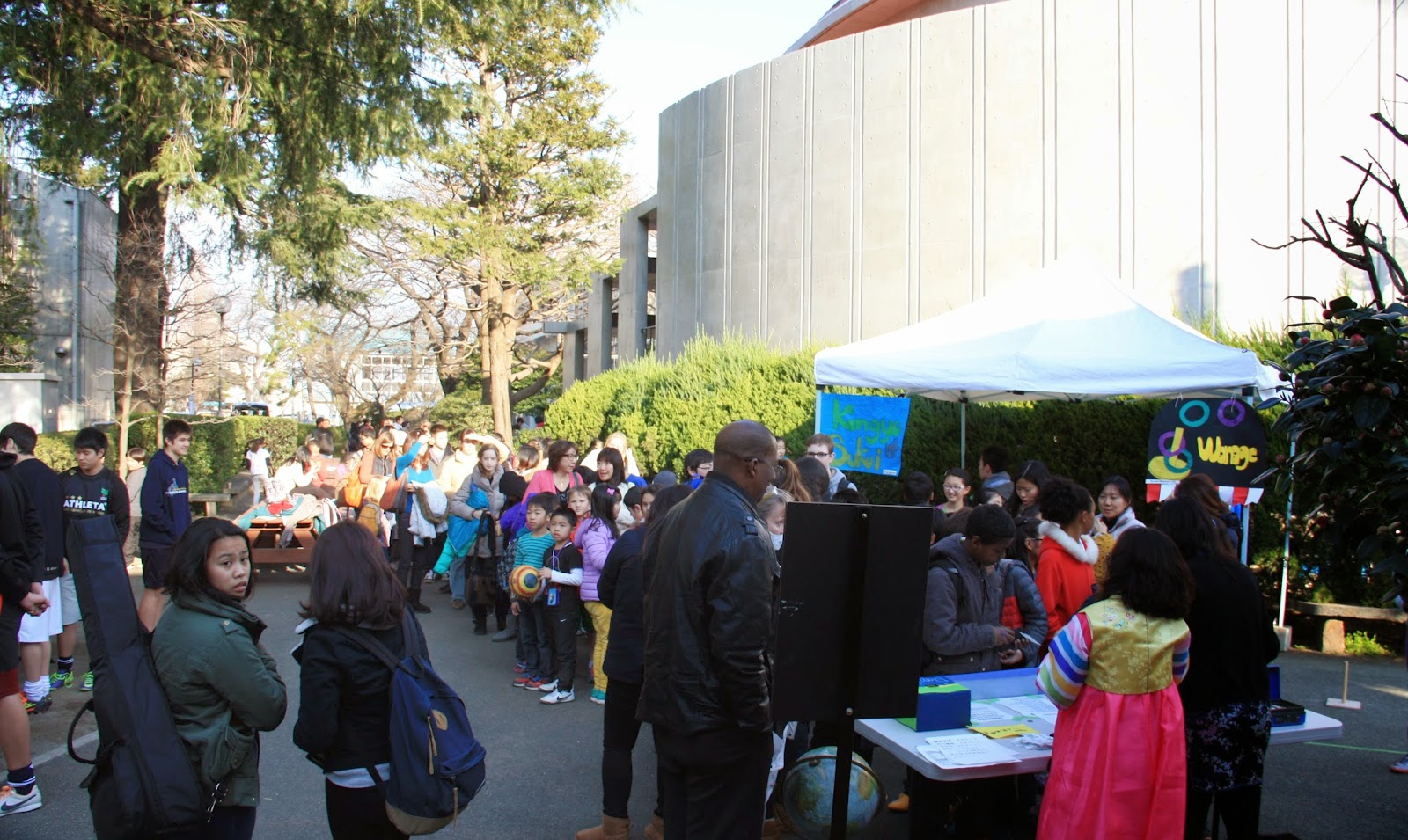
By 4:00, a long line had formed, winding back past the auditorium and the event began.  It was well-attended, and the Juniors (all wearing either traditional clothes from various countries, or sports gear from their home country) gave the two-hour festival their all.

The final tally of the funds they raised is not yet complete, but every indication says that the class exceeded their goal of ¥150,000.  

Parents, staff, and peers alike conveyed their amazement and appreciation for what the class of 2016 put together.  This will not be an event soon forgotten!

It was my exquisite privilege to observe the Juniors at every stage of this process.  This was not a requirement; no grade or school credit would be given for this.  Yet it was an extension of our class discussions from that very first unit, and an application of the theme I hold to be central to my 11th grade classes: Becoming People of Justice.  Yesterday, and in the six months leading up, the 11th graders invested in something much bigger than themselves, coming together as a class community with common purpose, sacrificing both time and energy, and seeking opportunities to serve and bless not only the local community, but the world at large.  They may well write about this experience in their final essays at the end of the year.  I hope they do.  But even for those who struggle on that last assignment, for those who always struggle to formulate and articulate their thoughts, I feel a deep sense of satisfaction that they lived out our theme firsthand.  I sincerely wish such moments were easier to recreate.  This year, I merely set the possibility before the students and they ran with it.  Next year, with this charity event still fresh in their memories, the class of 2017 will undoubtedly feel pressured or overwhelmed if I treat this in any way like an expectation.  Service, and by that same token, a genuine pursuit of justice, must come from the heart and not from the burden of tradition or expectation.  

The best I can do is to instill within my students, this year, next year and all the years yet to come, a deep desire to pursue justice.  Frustrating, for a teacher who wishes he could just plug "Junior service project" into his curriculum map, but oh, so crucial for a teacher who hopes for his students to leave his classroom with a heart to serve.


Wednesday, March 4, 2015

Writing Alongside


One thing I did not do enough as a Cross Country Coach, but which my runners always appreciated, was actually running the work-out with the team.  My final season of coaching, I did this consistently and I found it motivated my runners and it meant less groans when they found out their work-out for the day.

There's an element of this that can be brought into teaching, too.

My AP students are busy right now.  A number of them were away from school yesterday for a long Honor Choir rehearsal, and even more will be away from school tomorrow for the Kanto Plains Choir Festival.  The class charity festival is next Thursday and Spring sports have just started.  Not to mention, for many of them, English is not the only AP that they are taking.  With 24 students taking the AP English test, we've divided into three different groups that meet for weekly prep sessions at different times during the week.  As I waited for my Wednesday lunch group today, I felt a pang of guilt--it was 19˚C outside, the sun was shining, and here I was asking them to come inside during their lunch break and spend 50 minutes writing a practice essay.

The kids filed into the classroom one-by-one, good-natured, but looking distinctly beleaguered.  After a minute or two of small-talk, I introduced their practice essay prompt for the session and made a split-second decision:
"I'm going to write this essay, too!"
"Who would do something like that?" one boy asked incredulously.
"Me.  I feel like writing."

So as my students settled down to their task, I, too, put pencil to page and wrote a rhetorical analysis essay on how Mark Twain conveys his attitude in an excerpt from his classic "Fenimore Cooper's Literary Offenses."  As I collected the essays at the end of the session, I told the students I would type up my essay and send it out as a sample.

I was not happy with the conclusion, I told them, but felt as though I'd held to and supported my thesis fairly well.  In the end, joining them on this timed essay served a three-fold purpose:
1) It enabled me to model what (I hope) a decent rhetorical analysis essay should look like.
2) It demonstrated my love for writing.
3) It showed the students that I was willing to join them in the trenches.  Hopefully, it communicated a desire to empathize with them.

It was a spur-of-the-moment decision, but one I felt good about.  Just for fun (for better or for worse), here is my analysis essay on Twain's criticism of Fenimore Cooper:


****************


Styles change. What's popular now may not be popular in 50 years, 10 years, or even next week. So it was that Romantic author James Fenimore Cooper, with his copious descriptions, epic tone and cast of noble savages fell under Mark Twain’s keen eye. In this excerpt, Twain conveys a critical, satirical attitude, logically dismantling Cooper’s style with detailed examples, pointed cause-effect, and characteristic sarcasm.

Twain wastes no time in getting to the heart of the matter: “IF Cooper had been an observer…” While Twain maintains that Cooper “saw nearly all things as through a glass eye”, Twain proves himself to be far more observant as he brings detailed examples into his analysis. In particular, Twain points out Cooper’s inconsistency in describing the stream in “Deerslayer”. Twain has numbers at the ready: initially, Cooper describes the stream as 50 feet at its origin, but later reduces that measurement to 20 feet. Twain then goes on to speculate on the dimensions of Cooper’s ark, based on the description of a “modern canal boat.” 16 feet wide and more than 100 feet long, Twain assumes, and therefore conjures a ridiculous picture in the readers’ minds of a boat far too big for the stream it’s in.

These details and examples set up for a brilliant cause-effect. Twain supposes that Cooper “shrunk” the stream to accommodate the Indians who were waiting on a limb across the river to drop stealthily onto the 90 ft-long “house” portion of the boat. Given the dimensions, Twain establishes, the leap ought not to have been a problem: the house-boat is a wide, 16x90ft slow-moving target! The effect should not have been in question—each Indian should have made the leap easily. However, Twain points out that not only did all six Indians MISS the boat, all but one fell into the water (which, Twain reminds, accounted for less than two feet on either side).

Twain brings up all of these facts in his trademark sarcastic tone, asking mocking rhetorical questions: “Did the Indians notice that there was going to be a tight squeeze there?”; “Now then, what did the six Indians do?” Then, he fields his own questions with barely contained glee (“He was almost always in error about his Indians. There was seldom a sane one among them!”) and hyperbole (“It would take you 30 years to guess and even then you would have to give it up, I believe.”) He concludes with stinging anaphora as he describes the successive failures to land on the boat: “Then No. 2…,” “Then No. 3…” The cumulative effect of these strategies is that an epic moment from Cooper’s work now looks unrealistic and silly.

The times, they had changed. Out was the romantic literature of Cooper’s day and in was the clear, concise, realistic work of Twain and his fellows. Though both Cooper’s and Twain’s works have endured, one cannot help but admire Twain’s witty determination to dismantle the old set and introduce a new scene in the great drama of American literature.

Friday, February 27, 2015

EDUC 509: Self-Assessment

I wrote this reflection for my Master's course, having been asked to identify which stage of teacher development I am currently in and what growth options appeal to me:


“When teachers in Track II reach some form of closure with their professional development plan, they and their supervisor build a new plan and establish a new time line" (Danielson). And there you have it—the essence of growth as a teacher is continuous growth as a learner. Being enrolled in this Master’s program has been a tremendous professional renaissance for me. In my 4th full year of teaching in 2012-2013, I was struggling with what I can only assume was some kind of “senior-itis”, burned out on my work and feeling that it was time for some kind of a change (the curse of growing up in an educational system that treats every 4th year as a milestone of sorts). And change came in large quantities in 2013 as I got engaged, then married, and also started my graduate work. What I now realize is that I need to be proactive in my continual growth—complacency is the enemy of good teaching, as it will eventually rot into stagnation. As the end of my Master’s program draws nearer, I have begun to wonder what will come next. On the one hand, I will be happy with what I accomplished; on the other hand, I will be sorry to not have the next course to look forward to. I’m already feeling this, a year before I’ll finish up. On this count, chapter 9 encouraged me, as it affirmed that I am indeed now a “track II” teacher, and that ongoing learning is not merely a possibility, but a necessity.

Time flies. In my mind, I’m still a newbie. My first years of teaching do not feel all that distant, and they are not, really. Yet, I’m clearly in a different stage now than I was when I started, and even than I was two years ago. I’m thinking about aspects of my career and my school context that I wouldn’t have considered two years ago, and I’m thinking about these things on a much deeper level than I would have back then. This is because I’m no longer an inexperienced teacher. This is my 6th full year of teaching; my 5th teaching my current course-load and my 7th in the CAJ community. At graduation in June, when the teachers file into the gym according to years of service, I’ll be somewhere in the middle. I’m a track II teacher. It was my entrance into the Master’s program that initiated this rite of passage. The moment I took initiative for my ongoing growth and development was the moment when my professional identity came of age.

With this new stage of professional life comes new responsibilities, not the least of which is ensuring that I continue to grow in my ability to effectively teach my students. One day, I will pursue a doctorate in education—the question is not ‘if’, but ‘when’. I may pursue another Master’s course to enhance my knowledge of my subject areas, provided I can find a good distance learning program that will allow me to continue to teach at the same time. Then, of course, the options listed in chapter 9 provided a rich trove for me to choose from. Through PLCs, I’ve had the opportunity to engage in curriculum development, work that I relish in. I’ve participated in several book-studies, which is always enjoyable. Yet the rest of these options are ones that I have not yet explored formally: action research, instructional strategies implementation, peer consultation/coaching, professional growth portfolios. I’m not sure what I will choose to pursue after I finish my Master’s—perhaps some combination of action research and peer consultation/coaching, as this would be a structured way for me to keep actively learning and would provide me with others to learn alongside.

Two years ago, the future of my professional career seemed uncertain. I had no idea what lay ahead of me or if I even wanted to continue teaching. Today, I still cannot say for sure what my future holds, but I am secure in the knowledge that teaching will be a part of that future, and with it, ongoing learning.